Showing posts with label Emergency Preparedness. Show all posts

Sunday

9 Tips to Protect Yourself when RVing During a Tornado

Although San Antonio is far from Tornado Alley, we are not immune from the affects of tornadoes.  The "straight line winds" that we experience here can be just as damaging, not only for those of us who live here but also for travelers, especially for RVers. This year has been particularly treacherous for many states and tornado damages and loss of life.  Driving across the country in an RV can be very frightening when tornadoes are in the forecast. But there are tips to protect your family if a tornado crosses your path when RVing.  
What happens to an RV After Driving Through a Tornado
RV After Driving Through a Tornado
  • While driving to your destination...
  1. Carry and use a weather radio, cell phone or tablet (if internet is available) to keep apprized of any weather alerts where you are and to where you are going.
  2. Obviously it would be a best choice to not head into a town were tornadoes are likely, according to the forecast.
  3. If tornadoes are likely on the way to your destination, research the location of tornado shelters on your route. Know the County name of you current and destination locations to research tornado alerts on NOAA/National Weather Service.
You Never know what a Tornado Will Do
Nice Site to Stay in When the Weather is Fine

  • If your in an RV Park or campground...
  1. If the town you are visiting has tornado sirens, these will sound once a tornado watch is in effect locally.  This isn't always a fail-safe however, since there's often no warning of a tornadoes approach.  Many parks have public address systems or computer or email alerts that can be used if there are no sirens in town or if those have failed.  Also watch local weather or RV Park postings on info boards at the community center or office.
  2.  Unless tornadoes are very prevalent at your RV park, the park generally will not have a tornado shelter but there are often shelters in town.  If a tornado warning is announced you should head directly to a known shelter in town.  Don't forget your seat-belts when heading to safety. 
  3. If no shelter is available nearby, move out of your RV to a park bath and shower facility, using their shower or commode stalls as a shelter.  Stay close to the ground and cover your head and neck for safety.  Other stable structures can also be considered like a recreation hall or registration center, staying in the buildings center, searching out a closet or some similar protection.
RV Park demolished by Tornado
  •  If you are towing a vehicle...
  1. Get out of the trailer or RV and put on seat-belts. 
  2.  If you can get your trailer unhitched drive away from the storm, if possible, and towards a shelter, especially if you SEE a tornado forming. 
  3. Don't panic.  Drive away from it as safely as possible.
Always remember that preparation and awareness are the best ways to escape safely and/or avoid the danger altogether.

Anyone been traveling when a tornado warning turned into a tornado?  Please share your experience or any actions you took to bring you through it safely.


Teri welcomes you to Hidden Valley RV Park

Teri Blaschke is the RV Park operator of family owned HiddenValley RV Park in San Antonio, TX and writer of the park blog “A Little Piece of Country in San Antonio.” Teri contributes to various other blogs with a focus on either travel or social media and how it relates to the outdoor hospitality industry but her passion is serving the RV travel community by providing a memorable RV camping experience and growing the Hidden Valley RV family.  Connect with us on Google+, Facebook, Pinterest and Twitter@HiddenValleyRV

Saturday

When Red Meets Yellow...

Very few people LIKE snakes but they are a fact of life in many parts of the US, especially South and West USA.  Hidden Valley RV Park has even been graced by an occasional reptile of the long and slender type. An article in the August 2002 New England Journal of Medicine states that an estimated 2000 Americans are bitten by venomous snakes each year, but deaths from snake bite average only about five per year. Incidentally, Florida has the most cases.

Two main groups in the US, coral snakes and pit vipers.  


The Corals hail from Texas to the Carolinas with the exception of the Arizona Coral which inhabits its name state and New Mexico.  These pretty babies bite with small teeth instead of fangs.  Although there are snakes that are similarly colored, a coral can be identified by the alternating bands of red, yellow and black stripes, the red always touching the yellow.  The very similar Scarlet King Snake is nonvenomous.  The axiom "when red meets yella it's a dangerous fella," is one we've employed here at the valley.
Notices the red stripes bracketed in yellow identifying the venomous variety
Notice the Venomous version with the red bracketed between yellow


Pit Vipers include, rattlesnakes, water moccasins and copperheads and they can be found anywhere in the US.  Their name comes (I always thought it was because they liked pits) from the tiny "pit" between their eye and nostril.  The pit makes it so they can detect heat enabling them to find prey at night.  These more drab looking reptiles have retractable fangs which shoot venom into their prey or an unsuspecting human. There is the possibility of receiving what's commonly called a "dry bite" meaning one without venom.  Bites from old and small snakes have less venom.  Some have felt that venom from smaller snakes is somehow more poisonous or dangerous however recent studies have refuted that belief.
Distinguishing Marks of a Rattlesnake
Notice the "Pit" and the "Rattle"


Bites from both types can range from hurtful to debilitating to death dealing if not treated immediately.  Symptoms can range from a merely a stinging pain to inability to breath due to swelling to affecting the brain and spinal cord.

Treatment, Old and New


Over the years, methods of treatment have included tourniquets, making "X" cuts at or above the fang marks and sucking out the venom (eeww) and icing the site to slow down the venom.  These have proven highly ineffective and currently experts advise
  • washing the bite area with soap and water 
  • keeping the affected limb still and placed lower than the heart 
  • Keeping the victim calm
  • seeking medical help immediately.  

Just as with other allergic reactions the site may become swollen or bruised looking and bleeding could exist.  Even with a small amount of venom you may experience faintness or numbness of the tongue.  These are evidence of shock and need quick attention.

When you get medical attention, a doctor will use and antivenom serum that is produced by injecting a small amount of serum into an animals blood (usually a horse) which then causes their immune systems to produce antibodies to combat the venom. The antibodies are then harvested from the animal in a concentrated form so that it can act quickly to neutralize venom in a person bitten by a snake.  Many persons can have an allergic reaction to the serum itself and are usually given epinephrine to counteract the allergy.
Infographic of Snakebite Do's and Don'ts

Can Snakebite Be Prevented? How?


As with many emergencies, preparedness is the best policy.  The Center for Disease Control (and some years living in snake country myself) provides these tips for prevention whether enjoying the outdoors, boondocking, camping or hiking in the wild or even in residential areas:
  • Do not play with or aggravate snakes
  • Keep landscape clear of brush and debris
  • Wear shoes (even in your RV and house-we found a coral snake in our closet once)
  • Wear boots when walking in snake country
  • Develop a habit of watching where you step and place your hands (even/especially when gardening)
Especially are these tips essential for RVers who are involved in gateguarding since the sites are in virtual snake playgrounds.

Live and Let Live


Whereas some may go by the adage "the only good snake is a dead snake," there are at least four  reasons to just let them be.
  • They will most likely just leave YOU alone
  • Many snakes are non-poisonous and benefit society
  • Snakes prey on rodents that can be a damaging nuisance and health risk themselves
  • Snake venom, when extracted, is used for various applications including treatment of breast cancer as well as stroke victims and it can also help in heart attack treatment. Venom is also used in the medicines of blood pressure.
So, in all, snake venom is very helpful for mankind.  So think twice before hating any snake.


Teri Blaschke is the RV Park operator of family owned HiddenValley RV Park in San Antonio, TX and writer of the park blog “A Little Piece of Country in San Antonio.” Teri contributes to various other blogs with a focus on either travel or social media and how it relates to the outdoor hospitality industry but her passion is serving the RV travel community by providing a memorable RV camping experience and growing the Hidden Valley RV family.  Connect with , Facebook, Pinterest and Twitter@HiddenValleyRV and our RV Country Daily Magazine and don't forget to Say hello to the voice of Hidden Valley 


11 Must Have Apps to Survive A STORM


When natural (or unnatural) disasters strike at home, we’ve all seen the devastation they can cause; but what about when you’re on the road in your RV? Unfamiliar surroundings, not knowing local emergency methods and being unaware of even the sort of dangers that could arise, make dealing with storm related emergencies especially challenging when traveling. Getting emergency preparedness apps on your smartphone is one way to keep you and your family safe and prepared for any bad weather in your traveling path.


When traveling in different States of the U.S.

You probably already have a disaster-preparedness kit (if you don’t check out ready.gov for what to include.) Don’t count on working cell or WiFi service in a disaster, or power to charge your batteries. Keep charged backup batteries for mobile devices in your disaster kit.

These 11 apps are ones that we use or have learned about from our guests that can benefit RVers and travelers of all sorts.

1.  Get the latest weather no matter where you are traveling.


NOAA Weather app
NOAA's weather programs touch the lives of every American. Every day, decisions are made based on NOAA weather information -- from the mundane "should I pack an umbrella today?" to the most critical and potentially life-saving. With the mission to protect life and property, and enhance the United States' economy, NOAA's National Weather Service is the sole official voice of the U.S. government for all kinds of weather situations.

And now, it's all available on your smartphone. Click on these links to see the available downloads, some free, some for a fee.
Disaster Center App
For your android phone        For your iPhone

2.  Know where the disasters are.
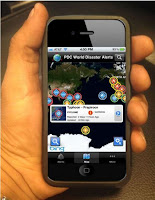
PDC has released a new version of its popular Disaster Alert, a free-download application ("app") for iPhone, iPad, and Android devices that provides users with instant access to worldwide hazards information. The app informs users of active hazards around the globe —current and near-real time incidents that are designated "potentially hazardous to people, property, or assets"—via maps and lists, with links to other useful information about the events and their potential impacts.  Download the disaster alert apps here. 


3.  First Aid/CPR Guidance
First Aid/CPR Guidance
The American Red Cross provides a first aid app with free lifesaving first aid instruction... and disaster preparedness information including videos, interactive quizzes and simple step-by-step advice.
There is a similar app from the American Heart Association for iPhones and for Androids


Hurricane Tracker App


4.  Hurricane Tracking and Preparedness
There are numerous hurricane tracking apps.  This American Red Cross link has their app plus links to several others as well.


5.  Earthquake App
Be ready for an earthquake with Earthquake by American Red Cross. Get notified when an earthquake occurs, prepare your family and home, find help and let others know you are safe even if the power is out – a must have for anyone who travels or lives in an earthquake-prone area or has loved ones who do.  It also includes an "I'm Safe" feature to notify family and friends that you are okay. Earthquake App 

From your mobile phone, call "**REDCROSS" (**73327677) and we will send you a link to download the app to your phone or you can download them directly from the iTunes or Google Play app stores.


6.  Wildfire Help
Be ready for a wildfire with Wildfire by the American Red Cross. Get notified about active wildfires, as well as fire weather warnings, prepare your family, home and pets, let loved ones know that you are safe even if the power is out – a must have for anyone who lives in an area that is susceptible to wildfires or has loved ones that do.  Get the app here.


American Red Cross Shelter Finder App
7.  Red Cross Shelter Finder
Offered by the American Red Cross, the application maps locations and shelter details across the United States. Zoom in to your local area. View shelter details: the agency managing the shelter, capacity of the shelter and current population, the associated disaster event and the specific shelter address and location.  Download the Shelter Finder Here. 


Point and Click Weather App
8.  Point and Click
When weather threatens the Point and Click App can keep you appraised of approaching severe weather. A variable distance selection can be set using miles or kilometers.
http://www.ilovefreeapps.com/point-and-click


GasBuddy.com


9.  Know where to obtain emergency fuel.
Locate gas stations near you and see their current gas prices. Get the Gas Buddy App Here.


10.  A Cutesy but handy app to keep you out of the dark

Never be caught without a flashlight.  This app is available for all devices and puts out a pretty good light.  Just remember to use it sparingly in an emergency to save your smartphone battery.
Just search your app store on your smartphone for flashlight apps and you'll find several. 


Dropbox for Mobile

11.  Dropbox
Dropbox lets you bring all your photos, docs, and videos anywhere and share them easily. Access any file you save to your Dropbox from all your computers, iPhone, iPad and even the Dropbox website!  Think emergency info!  You could transfer all your medical, allergy, blood type, etc. info easily on your smart phone.  If you needed medical help in a disaster this info could prove invaluable to medical personnel.  Download DropBox for Mobile Here. 


Don't' forget
It's best to download and familiarize yourself with these apps before you need them.  If the links in this post are only good for an Android or only for an iPhone, just search your App Store or marketplace on your smartphone for the app you need. 
Also, most people already have a map application on their cell phones.  Either use it or a regular map to familiarize yourself with your location and know the county you're in.  That's usually info you'll need to determine emergency conditions near you.  Hopefully you'll not need these apps and all your travels will be smooth sailing.

"We cannot stop natural disasters but we can arm ourselves with knowledge: so many lives wouldn't have to be lost if there was enough disaster preparedness."   Petra Nemcova


Teri Blaschke is the RV Park operator of family owned HiddenValley RV Park in San Antonio, TX and writer of the park blog “A Little Piece of Country in San Antonio.” Teri contributes to various other blogs with a focus on either travel or social media and how it relates to the outdoor hospitality industry but her passion is serving the RV travel community by providing a memorable RV camping experience and growing the Hidden Valley RV family.  Connect with , Facebook, Pinterest and Twitter@HiddenValleyRV

Say hello to the voice of Hidden Valley
Related Posts Plugin for WordPress, Blogger...