
Showing posts with label RV Safety. Show all posts
Showing posts with label RV Safety. Show all posts
Monday
Tips for Safe RVing


Thursday
Another RV Antenna Bites the Dust
If I pull out with my TV antenna up one more time I am going
to turn my keys in!
One of the most common things missed while getting ready to
pull out of a site is leaving the TV antenna up. I have even had people honking at me trying
to let me know that my antenna was sticking up and I actually waved at them
like they were my friends.

Sunday
9 Tips to Protect Yourself when RVing During a Tornado
Although San Antonio is far from Tornado Alley, we are not immune from the affects of tornadoes. The "straight line winds" that we experience here can be just as damaging, not only for those of us who live here but also for travelers, especially for RVers. This year has been particularly treacherous for many states and tornado damages and loss of life. Driving across the country in an RV can be very frightening when tornadoes are in the forecast. But there are tips to protect your family if a tornado crosses your path when RVing.
 |
| RV After Driving Through a Tornado |
- While driving to your destination...
- Carry and use a weather radio, cell phone or tablet (if internet is available) to keep apprized of any weather alerts where you are and to where you are going.
- Obviously it would be a best choice to not head into a town were tornadoes are likely, according to the forecast.
- If tornadoes are likely on the way to your destination, research the location of tornado shelters on your route. Know the County name of you current and destination locations to research tornado alerts on NOAA/National Weather Service.
 |
| Nice Site to Stay in When the Weather is Fine |
- If your in an RV Park or campground...
- If the town you are visiting has tornado sirens, these will sound once a tornado watch is in effect locally. This isn't always a fail-safe however, since there's often no warning of a tornadoes approach. Many parks have public address systems or computer or email alerts that can be used if there are no sirens in town or if those have failed. Also watch local weather or RV Park postings on info boards at the community center or office.
- Unless tornadoes are very prevalent at your RV park, the park generally will not have a tornado shelter but there are often shelters in town. If a tornado warning is announced you should head directly to a known shelter in town. Don't forget your seat-belts when heading to safety.
- If no shelter is available nearby, move out of your RV to a park bath and shower facility, using their shower or commode stalls as a shelter. Stay close to the ground and cover your head and neck for safety. Other stable structures can also be considered like a recreation hall or registration center, staying in the buildings center, searching out a closet or some similar protection.
 |
| RV Park demolished by Tornado |
- If you are towing a vehicle...
- Get out of the trailer or RV and put on seat-belts.
- If you can get your trailer unhitched drive away from the storm, if possible, and towards a shelter, especially if you SEE a tornado forming.
- Don't panic. Drive away from it as safely as possible.
Anyone been traveling when a tornado warning turned into a tornado? Please share your experience or any actions you took to bring you through it safely.

Teri Blaschke is the RV Park operator of family owned HiddenValley RV Park in San Antonio, TX and writer of the park blog “A Little Piece of Country in San Antonio.” Teri contributes to various other blogs with a focus on either travel or social media and how it relates to the outdoor hospitality industry but her passion is serving the RV travel community by providing a memorable RV camping experience and growing the Hidden Valley RV family. Connect with us on Google+, Facebook, Pinterest and Twitter@HiddenValleyRV
Thursday
The Most Important But Most Overlooked RV Tool
WHY IMPORTANT
Being an RVer myself and being here at Hidden Valley so
long, the most important RV safety tip I’ve learned has to do with your RV’s
electricity. You should ALWAYS have your
RV electrically protected. Why? Because electrical power is undependable
whether it is at your home or at an RV Park.
At our San Antonio RV Park we do everything possible to keep our
electricity upgraded and safe but wires can loosen, arc or even get hot from
ambient air temperatures. Many times parks are not in major cities and
regulations and inspections are not required. The local electric utility companies
themselves are often responsible for power surges. The first time you connect to a faulty
pedestal or encounter a power surge you will understand why this is important. An
RV surge protector can handle the critical issue of surge protection in a
recreation vehicle. Every RV's electrical appliances and circuit boards are at
threat as brown outs and other park power fluctuations are common occurrences
which can wipe out your electronics.

Like electronic equipment in your home, a recreational
vehicle's electrical system is very sensitive. When utilizing the power supply
at an RV park and with so many other vehicles in the area with high-end
electronics and power consumption there is almost a guarantee that one day this
will happen to you. When it does it will
disrupt your electronic equipment and could even cause damage to the point of
making your equipment completely inoperable. The only way to truly protect
against this is through the protection of a solid surge protector.
HOW THEY WORK
These devices promote RV electric safety and prevent
the unfortunate necessity of having to replace expensive equipment. Whether you experience a dip (current levels
dip below 110 volts) or a surge (over 132 volts) one of these units will
automatically shut off the power supply. When the indicator lights stop
blinking, the power will be restored. The indicator lights will alert you to
problems such as a incorrectly wired pedestal, reverse polarity and elevated ground
voltage. This is useful to protect your air conditioner compressor.

PORTABLE OR HARDWIRED
Sometimes it is advisable to stick to the hardwired devices
over the RV portable surge protectors. The portable models plug in outside of
the camper, so it is easy for someone to steal it. The hardwired devices install
inside the coach. You may want this security after spending a couple hundred
dollars on one. Typically a good protector will run you
around two to three hundred dollars. When you compare that to the expense of
having to replace a microwave or refrigerator due to surge it easily adds up to
a good deal. As to which RV surge protectors are the best: some have lots of bells and whistles and are great for
the somewhat tech savvy, but if that's not your thing and you like to keep it
simple, choose one of the more basic models.
In the end, one of the best-selling points for a quality RV
surge protector is that you will have peace of mind on the road that your
equipment will not be damaged. With that one device protecting your equipment
you will be able to relax and enjoy your journey on the open road.
RV Safety Tip From the Special Forces

Travel Bag
For travelers purposes a bailout bag is an easy to grab bag or folder with important papers kept in a handy place, like by the RV exit - that you could grab in case of a fire or other emergency. It should include medical information as well as insurance policies, copies of your registration - documents you would need if your RV was destroyed.
Survival/Disaster Bag
For survival purposes, a bail out bag would also include what you need to survive in the wilderness or areas where no food or medical supplies are available due to a natural disaster or even politically forced refugee situation. If you have several family members who may not all be at your RV or home together with the rest of the family, make sure to have discussions confirming where you will go in such cases, so a meetup place is prearranged.
Where would you locate it?
If you have a 5th wheel, you might want to have copies in your tow vehicle. In a motor home, perhaps having them by the exit door or up near the driving compartment would make sense. Of course, certain fires, depending on their location in comparison to yours, could mean you would not have access to your bailout bag. For example, in a 5th wheel, if a fire started in the kitchen area or in the refrigerator, you’d need to crawl out the emergency exit in the bedroom, which is a window. You could not get to the door. While you might have the intention to move the bag from doorway during the day to bedroom at night, I bet that wouldn’t last very long. The answer could be to have duplicates - in two or more locations, plus another set with a relative or in a safe deposit box. Of course in some emergency situations, a safe deposit box or family members home would probably not be beneficial. Make sure that all family members know the location of the bag(s).
In a sticks and bricks home, the same principles would apply - place in a location near an emergency/safe exit or even somewhere safe outside your home in a weatherproof box.
What to put in the bailout bag?
First you need to decide your purpose in preparing your bug out bag. If it is just for important papers, you would want to have copies of your vehicle insurance policies and perhaps a copy of the title and registration in the event the RV was a total loss. A list of credit cards and account numbers would be good if your computer were destroyed. Medical information would be good to have too, including prescriptions you take. Some of this information could be put on a flash drive, though you’d want to either password protect it (if possible) or be very sure it didn’t fall into the wrong hands. Emergency contact information would be essential too. Some people even have key photos. If it would be needed in an emergency, or hard to replace, it should go in the bailout bag. In addition to the bailout bag, some RVers have small fireproof safes in the RV, often built in, where they can keep certain things.
If your bag is primarily for emergency survival there are many more things to consider. First, water - enough for 3 days per person in your household. Dried foods are the most convenient to store and carry so I chose bags of dried foods. If you dehydrate your own foods, these can be included but may need to be changed out with fresh supplies every so often. We circulate our homemade supply monthly or so. Again there should be enough for 3 days for each person.

Have any other ideas as to what you'd include in YOUR bailout bag?
Let us know in the comments.
Space Heater Safety
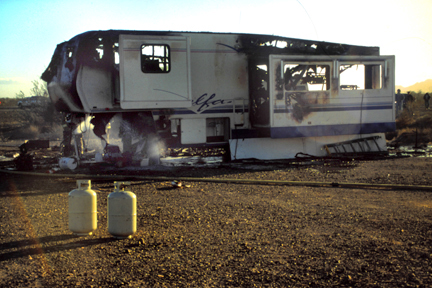
Just read a heartbreaking article about several recent RV fires connected to electric space heaters. It's nice to be able to save on propane, especially if the electric is included in your space rent but some safety precautions are in order to prevent loss of life and property and out of concern for others.
Inappropriately used space heaters can be linked to tragedy after tragedy. To avoid problems, here are some recognized safety tips:
- Buy a space heater that has been certified by a nationally recognized testing laboratory.
- Keep all furniture and combustible items at least three feet away from any heating device.
- Never use space heaters to dry clothing, towels or other combustibles.
- Never refill a fuel-burning space heater while it’s on or inside your house.
- Space heaters should not be left on while you are asleep or leave the room.
- When not in use, space heaters should be unplugged.
- Do not connect a space heater to an outlet with an extension cord, and never overload the circuit.
- Never use a space heater with a damaged or frayed cord, and never cover the cord with carpeting or furniture.
- Be sure your space heater is in good working condition and that the heating element is protected by a metal guard.
- Keep young children away from space heaters.
- Avoid using electric space heaters in a bathroom, and never touch an electric heater when you are wet.
- Make sure that your smoke and carbon monoxide detectors are working before using a space heater.
- Check the cord on an electric space heater to determine if it is very warm or hot. If so, unplug it immediately and try another outlet. If it continues to be hot, contact an electrician.
If you're considering a purchase a little research will help you to pick the best heater for your needs. If in a frigid climate you may want to heat your RV with the propane heater long enough to take off the chill and then use the electric heater, if necessary, to keep the heat. Here are some space heater guidelines and comparisons to aid you in your choice.
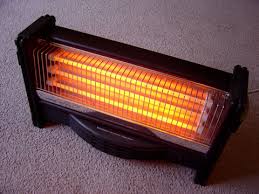
Radiant heaters use a variety of heating elements. Many use quartz tubes. Quartz heaters generally cost less than $70 and are rated between 750 and 1500 watts.
Parabolic heaters use a ceramic core. They cost a little more than quartz and put out about the same amount of heat per watt used. Ceramic element heaters are safer than heaters with coils. They use a larger heating area so it doesn't need to be as hot.
Halogen or reflective heaters use an energy saving halogen bulb to produce heat which is reflected on nearby objects. The feeling is much like having the sun shine on you.
Convection heaters can heat a whole room more quickly than a radiant heater. That works well if
 there are a number of people in the room or they're moving about within the room. Some convection heaters also have fans to circulate the air in the room. Convection heaters are inexpensive. You'll get one rated up to 5,000 Btu's for less than $50.
 Like radiant heaters, convection heaters use a variety of heating elements. Ceramic disc heaters cost up to $150 and produce up to 5,000 Btu's per hour.
Oil and water filled units are the most efficient convection heaters. They utilize a heating element in a bath of oil or water. Like a water heater, the element cycles on and off. The water or oil stays warm in it's container and heats the surrounding air.
Subscribe to:
Posts (Atom)
